Monkeys


Baboons


Elephants


Flamingos


Giraffes


Hyenas


Lions


Tuesday (June 5) - Maasai Village, Olduvai, Serengeti

We were given a tour of a house. These are little round huts built of mud, cow dung, and sticks. Extremely dark inside. Leather beds. A smoldering fire to keep the bugs out. Our host has three wives. Each wife has her own house, and he must move from one to the other.
Of course, we bought their jewelry - beaded bracelets, necklaces, and a "fly chaser". They don't sell their earrings, which I would dearly love to have.
Steve:
Woke up to a foggy day atop the crater. After breakfast, we drove back to the main road
along the crater rim, to arrive at Serengeti that night.
On the way, we made a couple of stops: first, at a Maasai village where the natives
encourage visitors. Upon arriving, we were met by one of the tribe who spoke English.
He welcomed us and encouraged us to take as many pictures as we wanted.
This was a gracious gesture on his part because many Maasai want money if
you take their picture.
We went into the middle of the village, where the women sang and the men danced.
According to Hassan, the dance was to celebrate the circumcision of a 15 year old male.
Part of the dance was that each male jumped up and down on both feet several times.
If I had been circumcised at 15, I’d be jumping up and down too.
Our host then invited us into his home, a hut made of straw and cow dung - not as
disgusting as you might think. It was very small, with a sleeping area for
him, a separate area for his wife, a fire pit in the middle, one small window for
ventilation and a spot for a guest to sleep. It was very dark inside, so much so
that when he invited me to take his picture, I couldn’t see his face through the viewfinder.
Afterwards, we were led outside to where the women displayed their beaded jewelry.
We bought a few pieces and as we were trying to add up how much everything cost,
one of the tribe members came over with a pocket calculator to assist.
We could have negotiated on the prices, but they were so low we figured that the
Maasai needed the money more than we did.
We then saw the school, where I gave the teacher two boxes of ballpoint pens I have
brought just for such an occasion.
We left the Maasai and went to the Olduvai Gorge, site of the oldest human
fossils ever discovered. This is the place where Louis and
Mary Leakey worked for over
40 years.

Rosemary: The real name of the place is Oldupai, not
Olduvai. Apparently the first European scientist to come here misunderstood the name,
and it became famous that way. There is a small museum and a local guide who gives
a short talk about the history of the place. He thinks the "p" vs. "v" mixup is hysterically funny.
On to the Serengeti.

On the road to the picnic are we saw lots of gazelles, some zebra, ostrich and eland, which are the largest antelope. Hassan thought there might be some cheetahs there, feasting on the gazelles, so we back-tracked a bit and went off road, into the grass. We saw all of the above (except cheetahs), plus a savannah hare and the skeletons of some recently killed zebra and wildebeest.
Rosemary: Lots of male lions. A group of three brothers just lying together on the savannah. We got close and circled them. One had a wound on his eyebrow. They were just relaxing, not bothered by us at all.
Steve:
We then saw another couple of solo males,
all of which were sleeping.
Further on, we saw a huge herd of zebra, some gazelles and more wildebeest. At one
point, one of the gazelles, after running quickly for a while, started hopping along,
like a circumcised Maasai.
Rosemary:
Lions, savannah hares, eland, topi, gazelles, zebra, vultures,
wildebeest, hartebeest,
bustard,
ostrich, warthogs, eagles - and more!
We saw plenty of dead animals, nothing left but a little skin and bone, or just bone.
One zebra by the side of the road was still being worked on by a flock of vultures.
Lions on the rocks. Big rain in the distance - the gazelles start hurrying toward it.
Steve:
As we made our way to yet another Sopa lodge,
we could see it raining across the plains
and we got a little sprinkle. A lot of the animals were headed towards the rainy area for
water and hoping for some new grass to grow in the next couple of days.
We arrived at the lodge a little after 5:00 PM, showered and went to dinner.
Rosemary:
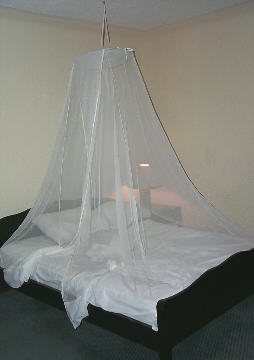
We have a fabulous view from our room. The plains, hills in the distance. Nearby giraffes
are eating the trees. Unfortunately, there is no screen on the glass door, so we can't
leave it open for ventilation. No ceiling fan, but there is a table fan in the room. It's very hot here.
As usual, hot water is rationed. Plumbing weirdness, also as usual. They put a
bidet
in every bathroom, but can't or won't install a properly designed shower. I suspect it's
a plot to keep people from using the hot water.
I really like the Serengeti, the little I've seen this afternoon. The smell of the grass
and the rain, the huge blue sky, animals everywhere. We drove off road for a while, and it
seemed as though we were the only people there. It's so vast, it really does seem endless.


May 30 (Wednesday) Arusha National Park
Steve: We woke at 6:00 AM from a fitful night’s sleep, showered and went to the dining room for breakfast. As we were seated, the staff knew our names and welcomed us as "Steve and Rose". Apparently, this is how our travel documents read, so it was a continuing theme through the trip for Rosemary to be called "Rose". (Editor’s note: kids, don’t try this at home.)
Rosemary: Sometimes I am respectfully called "mother", which is a typical way to address a married woman, who would also be known by her oldest son's name ("Mother Max").
Steve:
Breakfast was buffet, as it was at all the lodges we stayed at, with some juice, fresh fruit, omelette bar, breads &
breakfast meats. We met Hassan at 8:00 AM and drove to Arusha National Park. On the way, we drove through the
local weekly marketplace and saw produce being brought in from around the area, much of it balanced on the heads of the
local women.
The day started cool and overcast and warmed later on, but we never got the full African heat
we were afraid of.
Wildlife in Arusha National Park is protected from hunters, as was the wildlife in the other national parks we visited.
Sometimes, however, the animals leave the park and raid the local farms. There are also game reserves where hunting is allowed.
Hassan told us he used to lead game drives for hunters but quit because he didn’t like seeing the animals killed.
He must have been good at his job, though, because he has unbelievable eyesight, being able to spot animals a quite a
distance as he drives.
Rosemary: The lodge staff told us that if we need a wakeup call to
let them know and they'll knock on our door. There are phones in the rooms, but apparently
they don't actually work. (We brought an alarm clock.) Got up at dawn to the sound of birds
I'd never heard before -- and roosters!
It was market day. People sell fruits and vegatables, displayed on the ground. They carry large burdens
on their heads. A mixture of traditional and modern dress, some in full traditional clothes,
others fully western, but most combining elements, with women wearing colorful fabric
as a long wraparound skirt, often with a western-styled blouse or sweater on top.
There is a real flush toilet at the gate to Arusha National Park. But the elephants broke the
water pipe, so it was off to the pit latrine instead.

While hiking up to a vista point, we got attacked by safari ants, which are very quick and love to hide in your socks and pants legs. No one got bitten, but they were annoying and it took a while to get them off our legs.
Because there is no hunting, the animals are not as afraid of humans or vehicles, so we were able to get up pretty close to some of the animals. On our first day we saw:
|
baboons (many with babies) black & white colobus monkeys black crested eagle blue monkeys bush buck cape buffalo egret Egyptian geese flamingos (two kinds) francolin (bird) giraffes |
hippos hornbills red billed duck red duiker (a type of deer) royal crowned cranes sacred ibis spoonbills striped frog warthogs water buck zebra assorted birds |
Rosemary:
Lush vegetation, the forest very dense. Thick moss on
the trees, sometimes so thick more plants take root in it. Always bird
calls and insect sounds, monkeys
calling, buffalo
grunting.
The hippos were out of the water, unusual for them during the day, but today there was cloud cover so
they grazed at the edge of the lake. They all set down in a close group.
Lots of giraffes, sometimes very close to the road. They have big eyes and long lashes. Sometimes
they will stop to look at us.
All the animals are shy. Baboons
quickly vanish into the bushes. We saw where elephants had
recently trampled the grass and eaten, but no glimpse of the elephants themselves.
The narrow road is mostly just a muddy wheel track. A "traffic" jam was caused when three vehicles
stopped at the same viewpoint. But for the most part we saw very few other vehicles, and we had plenty of time
and peace to see what we wanted. Exhausted by the end of the day, we were falling asleep sitting up in the car on the way back to the lodge.
Steve: After a long and tiring day, we went back to the lodge for a short nap before dinner.
